

Introduction
Top career opportunities in data science think about how much data we create every single day. We search for products online, order food, make digital payments, watch videos, use social media, book tickets, and interact with different apps. Behind almost every one of these activities, there is data.
But here is the interesting part: data by itself is not very useful unless someone knows how to understand it.
Businesses need professionals who can look at large amounts of information, find meaningful patterns, understand customer behavior, predict what might happen next, and help companies make smarter decisions. This is where Data Science comes in.
Over the last few years, Data Science has become one of the most talked-about technology career fields. And now, with the rapid growth of Artificial Intelligence, Machine Learning, Generative AI, automation, and cloud technologies, the career possibilities are becoming even broader.
So, if you are thinking about starting a top career opportunities in Data Science in 2026–2027, you may have several questions:
-
- Is Data Science still a good career?
-
- Which Data Science jobs are in demand?
-
- Can freshers enter this field?
-
- What skills do employers look for?
-
- Should you become a Data Analyst or Data Scientist?
-
- How can you prepare for an AI-focused career?
In this blog, we will answer these questions in simple language and explore the top career opportunities in Data Science in 2026–2027.
What Is Data Science?
Before talking about jobs, let’s understand Data Science in the simplest possible way.
Data Science is the process of using data to understand problems, discover patterns, make predictions, and support better decisions.
For example, imagine an online shopping company.
It has information about millions of customers. The company may want to know:
-
- Which products are popular?
-
- What does a particular customer usually buy?
-
- Which customers may stop using the service?
-
- How much stock will be needed next month?
-
- Which products should be recommended to a customer?
-
- Are there any unusual or suspicious transactions?
A Data Science team can use data analysis, statistics, programming, and Machine Learning to answer these questions.
Therefore, Data Science is not just about coding. It is about using technology and analytical thinking to solve real business problems.
Why Is Data Science a Good Career Choice in 2026–2027?
There are several reasons why people continue to consider Data Science as a career.
1. Businesses Are Becoming More Data-Driven
Today, companies collect data from websites, applications, customers, transactions, advertisements, social media, and many other sources.
However, collecting information is only the first step.
Companies also need people who can turn that information into useful insights. As a result, professionals with data skills can find opportunities across different departments and industries.
2. Artificial Intelligence Is Creating New Opportunities
AI has changed the technology landscape significantly.
Machine Learning models, recommendation systems, chatbots, predictive systems, and Generative AI applications all depend on data in some way.
Moreover, the growth of Generative AI has created new areas such as AI applications, LLM-based solutions, AI automation, and RAG-based systems.
Consequently, people who understand both Data Science and AI can explore a wider range of career paths.
3. Data Science Is Useful in Almost Every Industry
One of the biggest advantages of Data Science is that it is not restricted to one industry.
Data professionals can work in:
-
- Banking
-
- Finance
-
- Healthcare
-
- E-commerce
-
- Retail
-
- Marketing
-
- Manufacturing
-
- Education
-
- Insurance
-
- Telecommunications
-
- Logistics
-
- Consulting
-
- Technology
Therefore, you can combine Data Science with an industry that matches your interests.
Top Career Opportunities in Data Science
Now let’s get to the main topic.
If you learn Data Science, what kind of career can you actually build?
Here are some of the major top career opportunities in data science to explore.
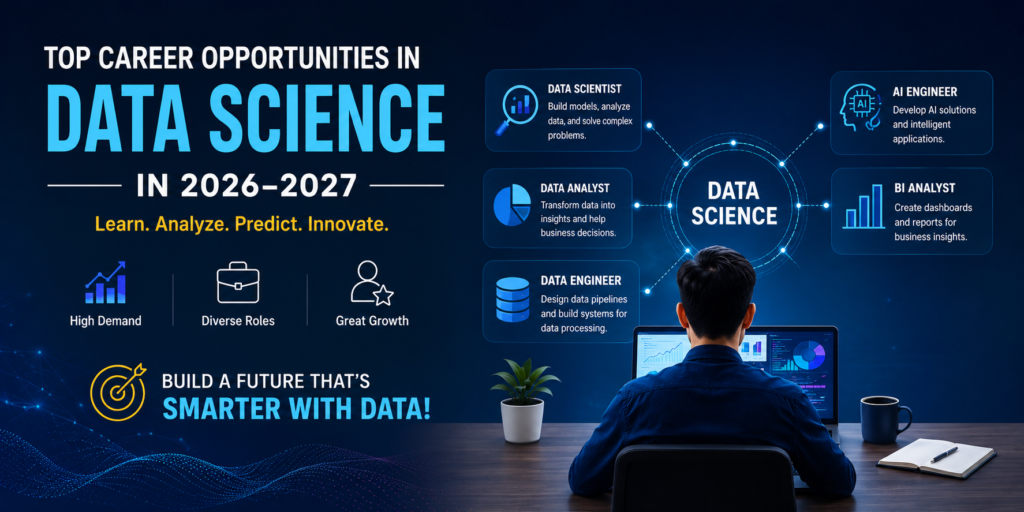
1. Data Scientist
When people hear the words “Data Science career,” Data Scientist is usually the first role that comes to mind.
A Data Scientist works with data to find patterns, solve complex problems, make predictions, and support business decisions.
For example, suppose an online company notices that many customers are not returning after their first purchase.
A Data Scientist can study customer behavior and build a model that helps identify customers who may leave in the future.
What Does a Data Scientist Do?
A Data Scientist may work on:
-
- Collecting data
-
- Cleaning data
-
- Exploring datasets
-
- Statistical analysis
-
- Finding patterns
-
- Building Machine Learning models
-
- Testing models
-
- Creating visualizations
-
- Presenting insights
-
- Working with business teams
Skills You Should Learn
If you want to become a Data Scientist, focus on:
-
- Python
-
- SQL
-
- Statistics
-
- Probability
-
- Machine Learning
-
- Pandas
-
- NumPy
-
- Data Visualization
-
- Model Evaluation
-
- Feature Engineering
At the same time, communication skills are also important because you may need to explain technical findings to people who do not have a technical background.
2. Data Analyst
If you are just entering the world of data, Data Analyst can be a good career path to consider.
Data Analysts generally work with existing data to understand what is happening in a business.
For example, if a company’s sales suddenly decrease, a Data Analyst might examine the data and find out which product, region, customer segment, or time period is responsible.
A Data Analyst May Work On:
-
- Data cleaning
-
- Data analysis
-
- Reports
-
- Dashboards
-
- Business insights
-
- KPI tracking
-
- Trend analysis
Common Tools
Some commonly used tools include:
-
- Excel
-
- SQL
-
- Power BI
-
- Tableau
-
- Python
-
- Pandas
So, if you enjoy numbers, reports, charts, and solving business questions, Data Analytics can be a practical starting point.
3. Machine Learning Engineer
If you enjoy programming and are curious about Artificial Intelligence, you may want to explore Machine Learning Engineering.
Machine Learning Engineers work on building, improving, and deploying Machine Learning models.
For example, the system that recommends products or videos based on your previous activity may use Machine Learning.
Important Skills
A Machine Learning Engineer may need knowledge of:
-
- Python
-
- Machine Learning
-
- Statistics
-
- SQL
-
- Algorithms
-
- APIs
-
- Cloud platforms
-
- MLOps
This career is generally more technical, so strong programming fundamentals can make a big difference.
4. AI Engineer
Artificial Intelligence is growing rapidly, and as a result, AI Engineer is becoming an increasingly interesting career path.
AI Engineers work on practical applications of Artificial Intelligence.
For example, they may develop:
-
- AI chatbots
-
- Virtual assistants
-
- Recommendation systems
-
- Intelligent search
-
- AI-powered applications
-
- Document-processing systems
-
- Generative AI solutions
Depending on the role, an AI Engineer may work with Python, Machine Learning, Deep Learning, NLP, APIs, and Generative AI.
Therefore, if you enjoy building technology and experimenting with AI, this career could be worth exploring.
5. Data Engineer
Before a Data Scientist can analyze data, that data needs to be collected, stored, organized, and made available.
This is where a Data Engineer comes in.
Data Engineers build systems and pipelines that help organizations manage large amounts of data.
Their Work Can Include:
-
- Building data pipelines
-
- Managing databases
-
- Data integration
-
- ETL/ELT
-
- Data warehouses
-
- Cloud data platforms
-
- Data processing
Skills
Useful skills include:
-
- Python
-
- SQL
-
- Databases
-
- ETL
-
- Data Warehousing
-
- Cloud technologies
-
- Big Data concepts
If you enjoy databases, programming, and technical infrastructure, Data Engineering may be a good fit.
6. Business Intelligence Analyst
A Business Intelligence Analyst, or BI Analyst, helps businesses understand their performance through reports and dashboards.
For example, management may want to know:
-
- How much did we sell this month?
-
- Which product is performing best?
-
- Which region has the highest revenue?
-
- How many new customers did we gain?
-
- Which business KPI is improving?
A BI Analyst can organize this information into dashboards that make it easier for decision-makers to understand what is happening.
Common Tools
-
- Power BI
-
- Tableau
-
- Excel
-
- SQL
Therefore, if you like both data and business decision-making, BI can be an interesting career direction.
7. Generative AI Specialist
One of the biggest changes in the technology industry has been the growth of Generative AI.
Generative AI can be used to create text, code, summaries, images, and other content.
Businesses are now exploring how they can use these technologies to automate tasks, improve customer support, search internal information, and increase productivity.
Career areas can include:
-
- Generative AI applications
-
- AI assistants
-
- Large Language Models
-
- Prompt design
-
- RAG applications
-
- AI automation
-
- AI-powered search
However, it is important not to focus only on individual AI tools.
Instead, build a strong foundation in Python, data, Machine Learning, APIs, and AI concepts. That foundation can help you adapt as AI technology continues to change.
8. NLP Specialist
Have you ever chatted with a customer-support chatbot or used voice search?
There is a good chance that Natural Language Processing (NLP) is involved.
NLP focuses on helping computers understand and work with human language.
It can be used in:
-
- Chatbots
-
- Search engines
-
- Sentiment analysis
-
- Translation
-
- Text classification
-
- Voice assistants
-
- Document analysis
If you enjoy language as well as Artificial Intelligence, NLP can be an interesting specialization.
9. Computer Vision Engineer
Another exciting area is Computer Vision.
Computer Vision focuses on helping computers understand images and videos.
It has applications in:
-
- Object detection
-
- Facial recognition
-
- Medical image analysis
-
- Manufacturing
-
- Security
-
- Autonomous systems
-
- Retail
So, if images, video, AI, and Machine Learning interest you, Computer Vision could be a career path to explore.
10. Product Data Scientist
Modern apps collect a lot of information about how people use their products.
A Product Data Scientist uses this information to help product teams understand users and improve the product.
For example, they might investigate:
-
- Why are users leaving the app?
-
- Which feature is most popular?
-
- How long do users stay?
-
- Which feature should be improved?
-
- Why are some customers returning while others are not?
Therefore, this role is a good option for someone who enjoys both data and product development.
11. Marketing Data Analyst
Marketing is no longer based only on creativity and assumptions.
Today, marketers also depend heavily on data.
A Marketing Data Analyst can help answer questions such as:
-
- Which campaign performed best?
-
- How many customers came from an advertisement?
-
- Which audience converts better?
-
- Where are customers dropping off?
-
- Which marketing channel provides better results?
They may work with:
-
- Website data
-
- Advertising data
-
- Customer data
-
- Conversion data
-
- Social media data
-
- Campaign performance
Consequently, people who understand both marketing and analytics can find interesting opportunities.
12. Risk and Fraud Analyst
With the growth of online payments and digital banking, detecting suspicious activities has become increasingly important.
Banks and financial organizations can use data analysis and Machine Learning to identify unusual patterns.
A Risk or Fraud Analyst may work on:
-
- Fraud detection
-
- Risk analysis
-
- Transaction monitoring
-
- Customer risk assessment
-
- Predictive analytics
If you are interested in both finance and data, this could be a useful specialization to consider.
Which Top career opportunities in Data Science Is Best for You?
There is no single answer.
The best career depends on what you enjoy.
If You EnjoyCareer PathNumbers and businessData AnalystStatistics and predictionData ScientistProgramming and AIMachine Learning EngineerArtificial IntelligenceAI EngineerDatabasesData EngineerDashboardsBI AnalystMarketingMarketing Data AnalystProducts and usersProduct Data ScientistFinanceRisk AnalystLanguage and AINLP SpecialistImages and AIComputer Vision Engineer
The good thing is that these careers are not permanent boxes.
For example, you can start as a Data Analyst and later move into Data Science.
Similarly, a Data Scientist can later specialize in Machine Learning or AI.
So, don’t worry if you haven’t decided everything yet.
Skills You Need for Top career opportunities Data Science in 2026–2027
Learning Data Science can feel overwhelming at first because there are so many tools and technologies.
However, you don’t need to learn everything at once.
Start with the basics.
Python
Python is one of the most widely used programming languages in Data Science.
Start with the fundamentals and then learn libraries such as Pandas, NumPy, and visualization tools.
SQL
SQL is extremely useful because a lot of business data is stored in databases.
Learn how to filter, combine, group, and analyze data using SQL.
Statistics
Statistics helps you understand data properly.
Learn concepts such as:
-
- Mean
-
- Median
-
- Probability
-
- Standard deviation
-
- Correlation
-
- Regression
-
- Hypothesis testing
Machine Learning
Once your basics are strong, start learning Machine Learning.
Begin with simple algorithms and gradually move toward more advanced techniques.
Data Visualization
Charts and dashboards make data easier to understand.
Therefore, tools such as Power BI, Tableau, Excel, and Python visualization libraries can be valuable.
Generative AI
Finally, start exploring Generative AI and understand how modern AI systems work.
But remember: AI tools can change quickly, while fundamentals remain useful for much longer.
Why Projects Matter More Than Just Certificates
Let’s be honest.
Completing a course is a good achievement, but a certificate alone does not demonstrate everything you can actually do.
Suppose your resume says:
“Knowledge of Machine Learning.”
An interviewer may immediately ask:
“What project have you built?”
This is where practical experience becomes important.
Instead of only learning theory, build projects such as:
-
- Customer Churn Prediction
-
- Sales Prediction
-
- Customer Segmentation
-
- House Price Prediction
-
- Fraud Detection
-
- Recommendation System
-
- Sentiment Analysis
-
- Power BI Sales Dashboard
Then, learn how to explain your project.
What problem were you solving?
What data did you use?
How did you clean it?
What method did you use?
What did you learn from the results?
By answering these questions confidently, you can demonstrate that you understand the practical side of Data Science.
Data Science Career for Freshers
If you are a fresher, you may be wondering whether companies will hire you without experience.
The answer is yes, but you need to build a strong foundation.
Instead of expecting to become a senior Data Scientist immediately, you can start by exploring roles such as:
-
- Data Analyst
-
- Junior Data Analyst
-
- Data Science Intern
-
- Business Analyst
-
- Reporting Analyst
-
- BI Analyst
-
- Analytics Associate
-
- Junior Data Scientist
As you gain experience, your career can gradually move toward more advanced roles.
Therefore, as a fresher, focus on:
Skills + Projects + Portfolio + Communication
These four things can make a big difference.
Can Non-Technical Students Learn Data Science?
Absolutely.
You don’t necessarily need a Computer Science degree to start learning Data Science.
Students and professionals from backgrounds such as:
-
- Commerce
-
- Mathematics
-
- Economics
-
- Finance
-
- Business
-
- Marketing
-
- Engineering
can develop data skills.
Of course, if you come from a non-technical background, programming and statistics may take some additional practice.
However, you can learn them step by step.
In fact, your previous experience can become an advantage.
For example:
Finance + Data = Financial Analytics
Marketing + Data = Marketing Analytics
Business + Data = Business Intelligence
So, instead of thinking that you are starting from zero, think about how your existing knowledge can work together with your new Data Science skills.
Top career opportunites in data science Career Roadmap for Beginners
If you’re completely new to Data Science, don’t try to learn Python, AI, Machine Learning, SQL, statistics, and everything else simultaneously.
That can quickly become confusing.
Instead, follow a simple roadmap.
Step 1: Learn Statistics
Start with basic statistics and probability.
Step 2: Learn Python
Understand programming fundamentals.
Step 3: Learn SQL
Learn how to work with databases.
Step 4: Learn Data Analysis
Work with real datasets using Python and other tools.
Step 5: Learn Machine Learning
Understand basic ML algorithms and how to evaluate models.
Step 6: Build Projects
Start solving practical problems.
Step 7: Learn Visualization
Create dashboards and meaningful charts.
Step 8: Explore AI and Generative AI
Once your fundamentals are strong, move toward modern AI technologies.
Step 9: Build Your Portfolio
Show your best projects online.
Step 10: Prepare for Interviews
Practice technical questions, case studies, SQL, Python, statistics, and questions related to your projects.
Most importantly, don’t rush.
Consistent learning is much more valuable than trying to finish everything in a few weeks.
Industries Where Data Science Professionals Can Work
One of the biggest advantages of Data Science is the variety of industries.
Banking and Finance
Data can be used for fraud detection, risk analysis, customer segmentation, and financial forecasting.
Healthcare
Healthcare organizations can use data for research, analytics, planning, and improving operations.
E-Commerce
Online businesses use data for product recommendations, customer analysis, personalization, and demand forecasting.
Manufacturing
Manufacturers can use analytics for quality control, predictive maintenance, and production planning.
Marketing
Marketing teams use data to understand customers and measure campaign performance.
Telecommunications
Telecom companies can analyze customer usage, network performance, and churn.
Logistics
Data can help companies improve delivery routes, forecast demand, and manage operations.
Education
Educational organizations can use analytics to understand student performance and engagement.
As a result, Data Science professionals are not limited to one type of company.
Data Science Top Career Opportunities in Delhi NCR
If you are searching for a Data Science Course in Delhi, Delhi NCR can be an attractive place to build your skills.
The region has a large ecosystem of technology companies, startups, consulting firms, financial organizations, e-commerce businesses, marketing agencies, and other industries.
Delhi, Noida, and Gurugram also provide a variety of professional opportunities.
However, remember that joining a course in Delhi alone does not guarantee a job.
Your skills, practical projects, portfolio, interview preparation, and ability to solve problems will matter as well.
Future Scope of Top career opportunities in Data Science in 2026–2027
The future of Data Science is closely connected with Artificial Intelligence.
As businesses continue to adopt AI, areas such as:
-
- Generative AI
-
- Large Language Models
-
- Predictive Analytics
-
- Machine Learning
-
- Data Engineering
-
- MLOps
-
- AI Automation
-
- Cloud Analytics
are likely to remain important areas of technology.
At the same time, professionals will need to keep learning.
A tool that is popular today may change tomorrow.
Therefore, instead of trying to memorize every new tool, build strong fundamentals and learn how to adapt.
That is one of the best ways to prepare for a long-term career.
How to Build a Successful Data Science Career
Building a Data Science career takes time.
There is no magic shortcut.
However, you can make the journey easier by following a few simple habits.
Practice Regularly
Don’t study for ten hours one day and then stop for two weeks.
Even one or two hours of consistent practice can be valuable.
Build Projects
Projects help you understand how concepts work in real situations.
Read and Explore
Follow Data Science and AI developments to understand where the industry is moving.
Improve Communication
Being able to explain your analysis clearly is just as important as performing the analysis.
Build a Portfolio
Keep your best projects organized and easy to understand.
Keep Learning
Technology changes quickly. Therefore, continuous learning is essential.
Frequently Asked Questions About Data Science Careers
What are the top career opportunities in Data Science in 2026–2027?
Some major career paths include Data Scientist, Data Analyst, Machine Learning Engineer, AI Engineer, Data Engineer, Business Intelligence Analyst, Generative AI Specialist, NLP Specialist, Computer Vision Engineer, Product Data Scientist, Marketing Data Analyst, and Risk Analyst.
Is Data Science a good career in 2026–2027?
Yes. The growing use of data, AI, Machine Learning, and automation makes Data Science a relevant career field. However, success depends on developing practical and up-to-date skills.
Can freshers get jobs in Data Science?
Yes. Freshers can start with internships, Data Analyst roles, junior positions, analytics roles, and other entry-level opportunities.
Is Python necessary for Data Science?
Python is highly useful and widely used for data analysis, Machine Learning, and AI. Therefore, learning Python is strongly recommended.
Is SQL important for Data Science?
Yes. SQL is an important skill because organizations often store their business data in databases.
Can a non-technical person learn Data Science?
Yes. Non-technical learners can learn Data Science by starting with programming and statistics fundamentals and progressing gradually.
What should I learn first?
A beginner-friendly order is:
Python → SQL → Statistics → Data Analysis → Machine Learning → AI
Is Data Science better than Data Analytics?
Not necessarily. They are different career paths.
Data Analytics focuses more on understanding existing data, reports, dashboards, and business insights, while Data Science generally involves programming, statistics, predictive models, Machine Learning, and more advanced analytical work.
How to Choose the Right Data Science Course in Delhi
If you’re planning to join a Data Science Course in Delhi, don’t make your decision based only on advertisements or course fees.
Instead, take some time to check the following.
Course Curriculum
Make sure the course covers important topics such as Python, SQL, Statistics, Data Analysis, Machine Learning, and Data Visualization.
Practical Training
Look for projects, assignments, case studies, and real-world datasets.
Trainers
Good trainers should be able to explain difficult concepts in a simple and practical way.
Projects
Check whether you will actually build projects during the course.
Career Guidance
Resume preparation, interview practice, and career guidance can also be useful, especially if you are a beginner.
In short, don’t just choose a course — choose a learning environment that helps you build practical skills.
About Tech Explica — Data Science Course in Delhi
If you are looking for a Data Science Course in Delhi and want to learn the subject in a structured and practical way, Tech Explica provides Data Science training for students, graduates, working professionals, and learners planning to move into data-related careers.
The course covers important areas of Data Science, including:
-
- Python
-
- SQL
-
- Statistics
-
- Data Analysis
-
- Pandas
-
- NumPy
-
- Machine Learning
-
- Data Visualization
-
- Power BI
-
- Tableau
-
- Generative AI
-
- Practical Projects
-
- Case Studies
-
- Assignments
The focus is not only on understanding concepts but also on getting learners familiar with practical applications of Data Science.
Moreover, working on projects and real-world examples can help learners understand how the skills they are learning can be applied in professional situations.
Conclusion
To sum it up, Data Science offers much more than just one job role in 2026–2027.
You can start as a Data Analyst, move toward Data Science, specialize in Machine Learning, explore Artificial Intelligence, work with databases as a Data Engineer, or choose areas such as Generative AI, NLP, Computer Vision, Business Intelligence, Marketing Analytics, or Risk Analytics.
The right choice depends on your interests, existing skills, and long-term goals.
Most importantly, don’t worry about learning everything at once.
Start with the basics.
Learn Python.
Understand SQL.
Build your statistics foundation.
Practice Data Analysis.
Then move into Machine Learning and AI.
Along the way, keep building projects and improving your portfolio.
Because ultimately, Data Science is not about knowing the maximum number of tools. It is about knowing how to use data to solve real problems.
And if you stay consistent, keep practicing, and continue learning, you can gradually build the skills needed to explore the growing top career opportunities in Data Science in 2026–2027.